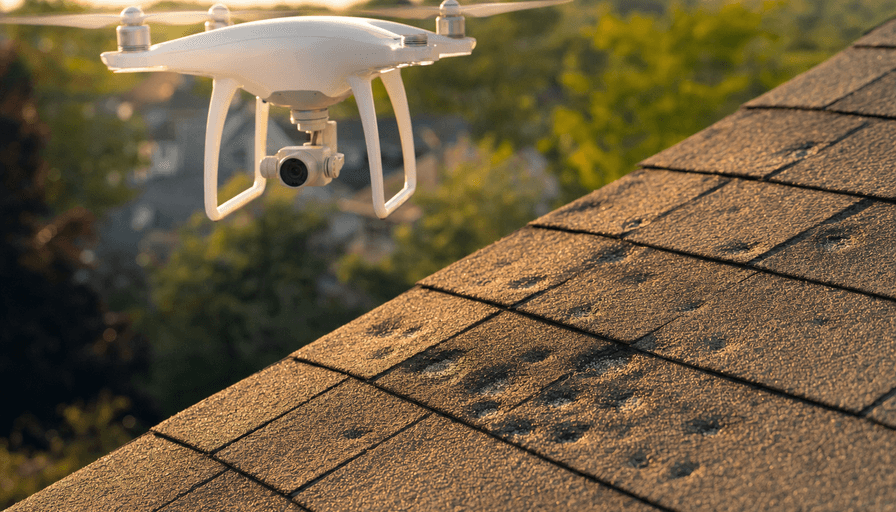
An adjuster who used to climb three or four roofs a day can now document eight to twelve from the driveway. That one change, more than any gadget appeal, is why drone roof inspection went from novelty to the default for a lot of storm claims and pre-purchase checks.
Here's what you'll know by the end: exactly what happens during the inspection, from the flight plan to the thermal pass to the report; why insurance carriers and adjusters moved to it; and what to expect when the deliverable lands in your inbox. If you're hiring a pilot or reading a report someone else produced, this is the part nobody explains clearly.
What actually happens during a drone roof inspection
A drone roof inspection is a short, structured flight that captures the whole roof in overlapping images, then turns them into a measurable, annotated report. On a single-family home it takes about 20 minutes on site. The process breaks into four steps.
1. The flight plan. Before the drone leaves the case, the pilot sets a flight path over the structure. For a simple roof that can be manual sticks. For anything with valleys, dormers, or a commercial footprint, the pilot loads an automated mission in an app like DroneDeploy so the aircraft flies a consistent grid at a fixed height. Consistent height matters: it keeps every photo at the same resolution, which is what makes the measurements later trustworthy. The pilot also checks airspace and weather, since wind above roughly 20 mph and hard rain both end the flight.
2. The capture pattern. This is the part that looks like nothing and is doing everything. The drone flies two passes. First a nadir grid, camera pointed straight down, marching back and forth so each frame overlaps the last by 70 to 80 percent. Then an oblique orbit, camera tilted, circling the roof to catch the angled shots of flashing, ridge lines, and fascia that a top-down view flattens out. Between the two you get a dataset with no blind spots. A good pilot on a cut-up roof will fire off 150 to 300 images.
3. The thermal pass (when it's ordered). If the job calls for it, the pilot swaps to or switches on a thermal sensor and flies the roof again, usually late in the day when trapped moisture holds heat differently than dry material. More on what that catches below.
4. The report. The images go into roof inspection software that stitches the images into a single orthomosaic and, often, a 3D model. From there the pilot or an AI-assisted review flags damage, drops measurements, and exports a PDF. Turnaround runs from same-day to about 48 hours. This drafting-and-stitching step is where a raw pile of photos becomes something an underwriter or a homeowner can actually act on.
Put together, a drone assisted roof inspection replaces the ladder, the harness, and the hour of a person crawling a slope with 20 minutes of flight and a documented file.
Why insurers and adjusters switched
Three reasons, in order of how much they mattered: safety, speed, and documentation you can defend.
Start with safety, because it's the one with a body count. Roofing is one of the deadliest jobs in the country. The Bureau of Labor Statistics counted 134 roofer deaths in 2023, and falls, slips, and trips caused about 82 percent of them. Falls are the leading cause of construction fatalities that OSHA tracks, year after year. Every roof an adjuster or inspector doesn't climb is a fall that can't happen. That math alone got risk managers interested.
Then speed. A single adjuster running manual inspections handles three to four properties a day. Hand that same adjuster a drone and the number jumps to eight to twelve, because the bottleneck was never the looking, it was the climbing, the setup, and the drive time spent on each roof. On the back end, one national carrier cut its claims review from about three hours to under one hour once drone imagery replaced field photos. After a hailstorm rolls through a metro, that difference is the whole ballgame.
Documentation is the quiet third reason. Every image a drone captures is geotagged and timestamped, so there's no argument later about which roof, which date, which slope. That kills a whole category of claims disputes. It's also why carriers accept the files at all. Insurers have been at this longer than most people realize: State Farm was the first carrier the FAA cleared to test commercial drones back in 2015, and after Hurricane Michael in 2018 it got a special waiver to fly beyond line of sight for catastrophe assessment. The rest of the industry followed.
If you want the wider picture of how carriers, contractors, and municipalities are using this, our overview of drone inspection services covers the other verticals. Roofs are just the highest-volume one.
What the thermal pass catches
A drone thermal roof inspection reads temperature, not shape, and that's exactly what makes it useful on problems your eyes miss. Wet insulation and trapped moisture hold heat longer than the dry material around them. As the roof cools in the evening, those saturated spots glow warmer on the thermal camera, mapping out a leak's footprint long before it stains a ceiling inside.
This is most valuable on flat and low-slope commercial roofs, where a membrane can fail under the surface and pond water for months without an obvious sign. It's also handy for spotting heat loss around poorly sealed penetrations. For a straightforward asphalt-shingle house with visible storm damage, thermal is usually overkill and you're paying for a sensor you don't need. The drones doing this work carry radiometric sensors, the DJI Mavic 3 Thermal, the Autel EVO II Dual 640T, or a Skydio X10, that record an actual temperature per pixel rather than a pretty false-color picture. If a leak's source is the question, that's the thermal drone services line item worth adding.
What to expect in the report
The deliverable is the whole point, so know what a good one looks like before you pay for it. At minimum you should get high-resolution stitched imagery of the full roof, close-up frames of any flagged damage, and measurements, square footage, slope, ridge and valley lengths, pulled from the model rather than eyeballed. If you ordered thermal, expect an overlay marking the suspect wet areas. Many pilots now include a 3D model you can rotate, and some add a short annotated summary calling out what needs attention and what doesn't.
One credential to check before you hire: the pilot must hold an FAA Part 107 remote pilot certificate. Any drone flight done for money falls under Part 107, and no serious insurer will accept a report from an operator who can't produce that certificate. It's the single fastest way to filter a real provider from a hobbyist with a Mavic. Pricing tracks the deliverable: a residential visual inspection runs roughly $150 to $400, and thermal adds another $300 to $700 depending on roof size and market. We break the numbers down by roof type and city in our guide to what a drone roof inspection costs.
If you'd rather not vet pilots one by one, you can compare drone roof inspection pros in Atlanta and other metros through our directory.
FAQ
How long does a drone roof inspection take?
Usually under 20 minutes on site for a single-family roof, longer for a large or complex commercial building. The stitched report comes back anywhere from the same day to about 48 hours later, depending on whether thermal and 3D modeling are part of the order.
Do insurance companies accept drone roof inspection reports?
Many do, and have for years. State Farm has used drones for roof claims since 2015, and geotagged, timestamped drone imagery is now standard evidence for storm and hail claims. The catch is that the operator must hold an FAA Part 107 certificate and the report needs the location and time metadata carriers rely on.
Is a drone thermal roof inspection worth the extra cost?
For flat or low-slope commercial roofs and any case where you suspect a hidden leak, yes, because thermal maps trapped moisture you can't see. For a standard asphalt-shingle house with visible storm damage, a regular visual inspection is usually enough and thermal is money you don't need to spend.
Can a drone inspection replace someone physically walking the roof?
For documentation, triage, and measurement, largely yes, and it does it more safely and with a better paper trail. A handful of conditions, like testing for soft or rotten decking underfoot, still call for a physical follow-up, but the drone tells you whether that trip is even necessary.
What does a drone assisted roof inspection cost?
A residential visual roof inspection with a drone runs about $150 to $400, with thermal adding roughly $300 to $700 and a 3D model another $100 to $200. Roof size, pitch, and your local market move the number. Our cost guide has the full breakdown.
The bottom line
Drone roof inspection isn't complicated once you see the sequence: a mapped flight, an overlapping capture pattern, an optional thermal pass, and a stitched report you can measure and defend. The documentation beats a ladder and a phone every time, and the safety math, fewer people on roofs that kill more than a hundred workers a year, is what actually tipped insurers from experiment to standard practice.
If you're pricing a project or a claim, browse drone service providers on DroneServices or start with drone roof inspection pros in your metro.