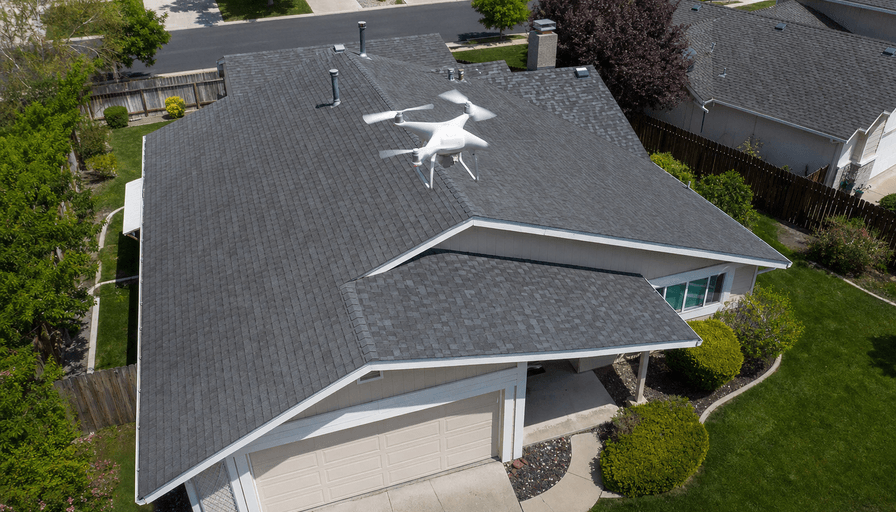
A drone roof inspection runs $150 to $400 for a typical single-family home in 2026. That's usually less than the $300 to $600 an inspector charges to climb up with a ladder, and you walk away with photos and a report you can keep.
But that headline number hides a lot. What you actually pay depends on who you are and why you're up there. A homeowner pricing a one-off pre-sale check, a roofing contractor documenting a storm claim, and an insurance adjuster who needs court-ready imagery are all buying the same 30-minute flight, and all three pay different prices for it. Below is what each of them should expect in 2026, when thermal imaging earns its extra cost, and how the whole thing compares to the old ladder-and-clipboard method. If you want the mechanics of the flight itself, our guide on how a drone roof inspection actually works covers the process end to end.
How much a drone roof inspection costs in 2026
Here's the 2026 price snapshot for the United States, before we split it by buyer type.
| What you're buying | Typical 2026 price |
|---|---|
| Residential visual inspection (photos + report) | $150 to $400 |
| Add a 3D model or orthomosaic map | +$99 to $199 |
| Add thermal (infrared) imaging | +$100 to $300 |
| Certified report for insurance or mortgage | +$75 to $200 |
| Commercial or multi-building roof | $500 to $1,500+ |
Most residential jobs land in that $150 to $400 band for a straightforward visual pass: the pilot spends 20 to 45 minutes on-site, captures a few hundred high-resolution photos, and sends back an annotated report within a day. Layer on a processed 3D model or an orthomosaic, the deliverable adjusters and contractors lean on for measurements, and you're looking at $250 to $600 all in. Thermal is its own line item, and we'll get to why it costs what it does.
Commercial roofs price differently because they're measured in acres, not squares. A small flat commercial roof might run $500 to $1,000, while a large warehouse or a campus with multiple structures pushes past $1,500 and, for the biggest flat roofs, into the low thousands. Even at the top of that range it's a fraction of what a manual commercial inspection with scaffolding and a safety crew costs.
Why the price moves: roof size, pitch, and material
The baseline everyone quotes assumes a roughly 2,000 square foot home with asphalt shingles and a normal pitch. Three things push you above it.
Size is the obvious one. More roof means more flight lines, more photos, and more processing time on the back end. Pitch matters less for the flying (the drone doesn't care how steep your roof is) and more for detail: steep and complex roofs with multiple valleys, dormers, and chimneys need more passes to get clean coverage of every plane. Material is the quiet cost driver. Slate, clay tile, and wood shake are harder to assess from imagery than a flat field of asphalt shingles, so a pilot who knows those materials will often charge for the extra interpretation time.
The reason a drone handles all of this well is that steepness and height stop being a safety problem. A ladder inspector charges a premium for a steep or multi-story roof because it's dangerous and slow. A drone flies the same pattern over a single-story ranch or a three-story Victorian, which is exactly why the pricing curve is flatter than the traditional one.
Homeowner vs contractor vs insurer: same flight, different price
This is where the single "cost" number breaks down. The flight is nearly identical. The deliverable, the volume, and the price are not.
Homeowners pay retail. You're buying one inspection, usually before a sale, after a storm, or because you spotted a stain on the ceiling. Expect the full $150 to $400 for a visual pass, and don't pay for a 3D model or thermal unless you have a specific reason to. What you want is a clear go or no-go and photos that back it up. If a contractor is offering the inspection "free" as part of a repair bid, remember you're paying for it somewhere in the quote.
Roofing contractors pay wholesale or nothing. A contractor who outsources to a drone pilot at volume can negotiate $75 to $200 per job, because the pilot is running several inspections in one neighborhood on the same day. Many mid-size roofers now fly in-house instead, which turns the "cost" into amortized hardware plus a certified pilot's time. Either way, the inspection is a sales and documentation tool: it lets them bid accurately without sending a crew up, and it produces before-and-after imagery that shortens disputes. The software matters here as much as the drone, and picking roof inspection software that turns the flight into a report is often the bigger decision than the aircraft itself.
Insurers and adjusters pay for documentation, not just pictures. An adjuster needs imagery that's timestamped, geolocated, measurable, and defensible if a claim is contested. That usually means an orthomosaic plus a certified report, so the $75 to $200 certification add-on is standard rather than optional, and thermal often comes along for water-intrusion claims. Carriers increasingly accept drone documentation to triage claims faster, though many still send their own adjuster before cutting a check. If you're an adjuster or a property manager running periodic checks across a portfolio, the recurring-inspection math is closer to our drone inspection services overview than to a one-off homeowner quote.
When thermal imaging is worth the extra cost (and when it isn't)
Thermal adds $100 to $300 to a residential inspection, and the reason is hardware, not markup. A capable visual drone like the DJI Mini 4 Pro costs around $759. A radiometric thermal platform is a different animal: the DJI Mavic 3 Enterprise thermal model runs about $5,449, and the Matrice 4T, with its 640 by 512 radiometric thermal sensor, built-in RTK, and laser rangefinder, is closer to $7,849. When a pilot shows up with a $5,000 to $8,000 aircraft, that shows up in the invoice.
So when is it worth it? Thermal sees what the visual camera can't: temperature differences that reveal trapped moisture and missing insulation under a surface that looks perfectly intact. That makes it genuinely useful for a handful of jobs.
- Diagnosing an active leak when the entry point isn't obvious from photos
- Flat commercial roofs, where trapped water under the membrane is the classic failure mode
- Storm-damage insurance claims that hinge on proving water intrusion
- Post-repair verification that a fix actually sealed
When is it a waste? On a dry, pitched, asphalt-shingle roof where you're checking for cracked, curled, or missing shingles, a plain visual pass finds everything thermal would, for a third of the price. Don't let anyone sell you a thermal upgrade for a routine pre-purchase look at a roof in good shape. If your situation genuinely calls for infrared, our rundown of thermal drone services gets into what a proper thermal deliverable should include.
Drone vs a traditional ladder inspection
A traditional physical inspection isn't dead, and it isn't always more expensive. A basic ladder check on an accessible, low-slope roof can run as little as $75 to $200. A standard professional inspection lands around $150 to $400, and steep or complex roofs push toward $400 to $600 and up, precisely because the height and pitch that a drone shrugs off are what make a manual inspection slow and risky.
Cost aside, the two methods do different things well. The drone wins on safety, speed, access, and repeatable imagery you can pull up next year to compare. Nobody climbs up, so there's no risk of a boot cracking a tile or a ladder gouging a gutter. What a drone can't do is touch the roof. A hands-on inspector can lift a shingle to check the seal, press on decking to feel for soft spots, and clear debris from a valley. For a lot of buyers the smart play is to use the drone for triage and documentation, then send a person up only if the imagery flags something that needs a tactile check.
One trust note that applies no matter which method you pick: any pilot flying a paid inspection is running a commercial operation, which means they must hold an FAA Remote Pilot Certificate under Part 107. It's a fair question to ask before you hire, and a legitimate operator will answer it without blinking.
Frequently asked questions
Is a drone roof inspection cheaper than a regular one?
Usually, yes. A drone inspection runs $150 to $400 for most homes in 2026, while a traditional ladder inspection runs $300 to $600 and climbs higher for steep or multi-story roofs. The gap widens on tall or complex roofs, where manual access gets slow and dangerous but a drone flies the same pattern regardless.
Will my insurance accept a drone roof inspection?
Many carriers accept drone imagery as documentation, especially an orthomosaic with timestamps and measurements, and some use it to triage claims faster. That said, your insurer may still send its own adjuster before approving a claim, so treat the drone report as strong supporting evidence rather than a guaranteed substitute.
Do I actually need thermal imaging?
Only if you're diagnosing a leak or trapped moisture you can't see. Thermal detects temperature differences under an intact-looking surface, which matters for active leaks, flat commercial roofs, and water-intrusion claims. For checking cracked, curled, or missing shingles on a dry pitched roof, a standard visual inspection is enough and costs less.
How long does a drone roof inspection take?
The flight itself is quick, typically 20 to 45 minutes on-site for a residential roof. Most providers deliver the annotated report the same day or the next, and add a bit more turnaround time if you've ordered a processed 3D model or thermal analysis.
Does the drone pilot need a license?
Yes. Any paid drone flight is a commercial operation under FAA rules, so the pilot must hold a Part 107 Remote Pilot Certificate. Ask for it before you hire; a licensed operator will happily confirm it.
The bottom line
Drone roof inspections are cheaper, safer, and more repeatable than sending someone up a ladder, but the price you pay only makes sense once you know which buyer you are. Homeowners should pay retail for a clean visual pass and skip the add-ons unless there's a reason. Contractors should treat it as a documentation tool and weigh flying in-house. Adjusters should budget for the certified, measurable deliverable they actually need. And nobody should pay thermal prices for a job a visual camera handles fine. Match the deliverable to the reason you're inspecting, confirm the pilot's Part 107 certificate, and you won't overpay.
Browse drone service providers on DroneServices to compare quotes, or see drone pilots in Atlanta if you want local operators who already know your market.