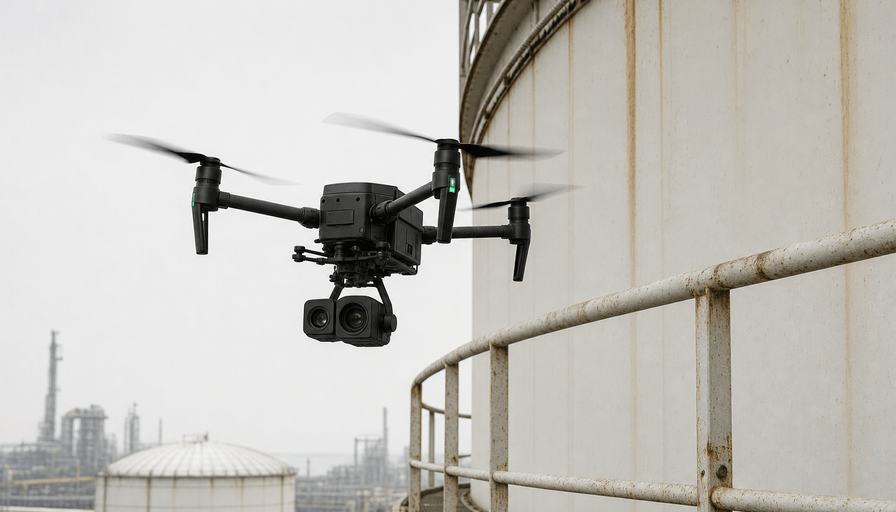
The hard part of hiring a drone inspection company isn't finding one. It's telling the outfit that shows up with a radiometric thermal payload, a Part 107 pilot, and a $1M insurance certificate apart from the guy who bought a Mavic last month and now calls himself a service. Both will quote you. Only one will hand you something an engineer, an adjuster, or a bank will actually accept.
This guide is the filter. By the end you'll know the non-negotiable minimums (certification and insurance), how to match the drone's sensors to your actual job, what separates industrial-grade providers from generalists, and how to read a sample report so you can spot a folder of pretty JPEGs before you sign.
Start with the two things that aren't optional
Before you compare price, confirm two things. If a company can't produce both on request, stop there.
First, a valid FAA Part 107 Remote Pilot Certificate. Any paid drone flight in US airspace is commercial, which means the pilot needs Part 107, full stop. The certificate has to be renewed every 24 months through a recurrent knowledge test, so ask for the pilot's certificate number and confirm it's current, not something they passed in 2021 and let lapse. If your site sits near an airport, they'll also need LAANC authorization to fly in controlled airspace, and every drone in the air has to broadcast Remote ID.
Second, insurance. The FAA doesn't legally require it, but that's a trap for buyers, because it means plenty of operators skip it. You want proof of at least $1M in aviation liability coverage before anyone flies over your property or your crew. A real company carries an annual policy (typically $500 to $2,000 a year for $1M in coverage) or an on-demand policy that costs a few dollars an hour. Ask for a certificate of insurance made out to you.
One detail most buyers miss: the sensor may not be covered. Standard liability often excludes the payload, so if the job depends on a $10,000 thermal camera, confirm hull and payload coverage in writing. A pilot who knows exactly what their policy does and doesn't cover is telling you something good about how they run.
Match the sensor to the job, not the drone to the brochure
A drone is just the truck. The sensor is the work. The most common way buyers overpay is hiring a full radiometric thermal package for a job that needed a good zoom camera, or the reverse, hiring a cheap RGB shooter for a job that genuinely needed thermal.
Here's the practical mapping:
- High-resolution visual (RGB). Cracks, corrosion, missing fasteners, general condition. A DJI Mavic 3 Enterprise or a Matrice 350 RTK with a zoom camera covers most roof, facade, and structural condition work. This is the default, and it's the cheapest.
- Radiometric thermal. Moisture under a membrane, delaminated roofing, overheating electrical connections, solar panel faults. "Radiometric" matters: it records an actual temperature per pixel, not a pretty orange picture. A Mavic 3 Thermal or Matrice 4T carries a 640x512 radiometric sensor. If a provider says "thermal" but can't tell you the resolution and whether it's radiometric, they're guessing.
- Confined spaces. Tanks, boilers, pressure vessels, sewers. This is a specialty. The Flyability Elios 3 flies inside a collision-tolerant cage and maps the interior with onboard LiDAR. A standard outdoor drone can't do this job at all, so don't let a generalist talk you into trying.
- NDAA-restricted sites. Government, defense, and some critical-infrastructure work can't use Chinese-made drones. The US-built Skydio X10 is the usual answer, and a provider serving that market will know it without being asked.
The takeaway for your budget: a straightforward drone roof inspection runs about $150 to $400 in 2026, while multi-sensor commercial and industrial work bills $300 to $700 an hour and larger engagements land anywhere from $4,000 into five figures. If you want the full breakdown by job type, our guide to drone roof inspection and the thermal drone services explainer both dig into where the money actually goes.
Industrial work needs more than a pilot
For a barn roof or a listing, a Part 107 pilot with a good camera is genuinely enough. For a refinery flare stack, a transmission tower, or a pressure vessel, it isn't close. Industrial inspection is a regulated trade, and the drone is just the delivery method for a qualified inspector's judgment.
Ask whether the person interpreting the imagery holds an ASNT NDT credential (typically Level II) for the relevant method, most often visual testing for drone-based work. For pressurized assets and storage tanks, the inspection has to align with API and ASME standards, and the deliverable often needs a Professional Engineer's stamp to satisfy a regulator or insurer. A drone company can be perfectly legal under Part 107 and still be completely unqualified to sign off on a boiler.
This is the single biggest sorting line in the market. The companies ranking at the top for industrial terms are inspection firms that added drones, not drone hobbyists who found a niche. If your asset is high-value, hard to access, or tied to safety and uptime, hire the former. Our industrial drone services overview covers the certification landscape in more depth, and the same logic applies to specialized verticals like powerline inspection and construction site monitoring, where the reporting standard is set by the client's engineers, not the pilot.
Judge the deliverable, not the drone
Anyone can fly. The thing you're actually paying for is the report, so ask to see a real one from a comparable job before you commit. A sample report tells you more than any sales call.
A serious deliverable includes GPS-referenced, high-resolution imagery tied to specific locations on the asset; a defect log that names each finding, rates its severity, and recommends an action; and, where relevant, an orthomosaic or 3D model you can measure against. If thermal was part of the scope, you get the radiometric data with temperature values, not just colorful images. Turnaround should be a stated number of business days, in writing.
Now the red flags. A "report" that's a shared drive full of unlabeled JPEGs isn't a report. Vague coverage claims ("we inspected 95% of the roof") with no methodology behind them are a dodge. No sample available, no references from similar buildings, no severity rating on defects, pricing that won't commit to a number: any one of these is a reason to keep looking. The gap between providers here is enormous, and it rarely shows up in the quote.
Questions to ask before you sign
Five questions will separate the field faster than a dozen quotes:
- Can you send your Part 107 certificate number and a certificate of insurance for at least $1M, made out to us?
- What drone and sensor will you use for this specific job, and why that one?
- Can I see a sample report from a job like ours?
- Who interprets the data, and what are their credentials? (For industrial: which ASNT or PE certification?)
- What's the turnaround, and what exactly is in the final deliverable?
A strong provider answers all five without friction and often volunteers the details before you ask. Hesitation on insurance or the sample report is the answer.
FAQ
How much does a drone inspection cost in 2026?
A single-asset job like a drone roof inspection typically runs $150 to $400. Multi-sensor commercial and industrial inspections bill roughly $300 to $700 per hour, and large or complex engagements (multiple structures, thermal, engineered reporting) can run from $4,000 into five figures. Price tracks the sensor, the size of the asset, and whether a certified inspector signs the report.
Do drone inspection companies need to be FAA certified?
Yes. Any drone flight you pay for is a commercial operation, so the pilot needs a current FAA Part 107 Remote Pilot Certificate. Near airports they also need LAANC airspace authorization, and every drone must broadcast Remote ID. Ask for the certificate number and confirm it hasn't lapsed.
What certifications should an industrial drone inspection company have?
Beyond Part 107, look for an ASNT NDT credential (usually Level II) for the inspection method, alignment with API and ASME standards for tanks and pressure vessels, and the ability to deliver a report with a Professional Engineer's stamp when a regulator or insurer requires it. A pilot certificate alone does not qualify a company to inspect a boiler or a flare stack.
Are drone roof inspections accepted by insurers?
Increasingly yes, when the report meets the carrier's standard: GPS-tagged imagery, a clear defect log with severity ratings, and often a licensed professional's review. A folder of raw photos usually isn't enough. Ask your provider whether they've had reports accepted by your specific carrier.
Can a drone inspect the inside of a tank or confined space?
Yes, but only with the right equipment. Confined-space work needs a collision-tolerant drone built for it, such as the Flyability Elios 3, which flies inside a protective cage and maps the interior with LiDAR. A standard outdoor drone can't do this safely, so treat confined-space inspection as a distinct specialty when you shortlist providers.
The bottom line
Choosing a drone inspection company comes down to three filters, applied in order: confirm the certification and insurance floor, match the sensors and inspector credentials to what your asset actually requires, and judge the sample report rather than the drone. Get those right and the price sorts itself out, because you'll be comparing companies that can actually do your job instead of guessing which quote hides a hobbyist. Browse vetted drone inspection providers on DroneServices, or start with the operators serving drone pilots in Atlanta if you want to see what a qualified local shortlist looks like.