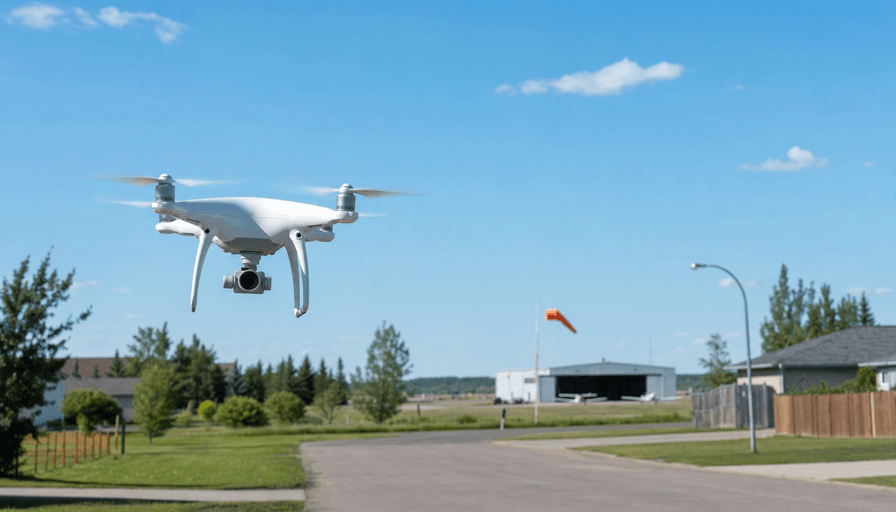
If a drone flies over a home you're trying to sell, someone on that job needs an FAA Part 107 license. Not a nice-to-have. The law. It doesn't matter whether you charge for the aerial shots, bundle them free with the listing, or borrow a buddy's Mavic for one quick pass over the roof.
There's a "real estate drone photography license" people search for, and the honest answer is that no such standalone thing exists. What exists is the FAA's Part 107 Remote Pilot Certificate, and any drone flight tied to selling a property falls under it. So this piece answers the two versions of the question you're probably actually asking: do I need to get certified myself, and if I'd rather hire it out, how do I confirm the pilot I'm paying is legit? By the end you'll know the 2026 cost, the test, the realistic timeline, what you risk by skipping it, and how to check a certificate in about two minutes.
Do you need a license to shoot listings with a drone?
Yes. The FAA treats any drone flight that isn't purely recreational as commercial, and it draws the line on intent, not on whether money changed hands. Photographing a house to help sell it is a business purpose, full stop. That's true if you're a real estate photographer billing $250 a shoot, an agent flying your own listing for free, or someone doing a neighbor "a favor" before an open house.
The National Association of Realtors takes the same position and has for years: agents using drone imagery in marketing need to either hold a Part 107 certificate or hire a certificated pilot. There's no square-footage exemption, no "it was only 90 seconds" exemption, and no exemption for flying over your own client's property. If the footage supports the transaction, it's commercial, and commercial means Part 107.
This is the single most common mistake we see agents make: assuming that because the drone is cheap and the flight is short, the rules don't apply. They apply the moment the photo hits the MLS. If you're weighing whether to fly it yourself or bring in a pro, our overview of real estate drone services walks through both paths.
What Part 107 costs and how long it takes in 2026
The certificate itself is cheaper than most people expect. Here's the actual math for a first-timer in 2026:
- Knowledge test: $175, paid at an FAA-approved PSI testing center. You pay it whether you pass or fail.
- Drone registration: $5, good for three years, done online at FAA DroneZone.
- Study materials: $0 to about $150, depending on whether you self-study with free FAA material or buy a prep course.
So the hard floor is $180. Call it $200 to $350 once you factor in a study course, which most first-timers should buy because the test is not a formality.
To sit the exam you have to be at least 16, able to read, speak, and understand English, in a physical and mental condition to fly safely, and you have to pass TSA security vetting (that happens automatically when you apply for the certificate afterward). The FAA's official steps for becoming a certificated remote pilot lay out the full sequence.
The test is 60 multiple-choice questions, and you need 70% to pass. It's not about flying skill. It's aeronautical knowledge: reading sectional charts, airspace classes, weather products like METARs and TAFs, loading and performance, Remote ID rules, and emergency procedures. Most people who study land in the 80s. The 2026 pass rate has been running around 83%, so it's very passable, but the people who fail are almost always the ones who skipped the airspace and chart-reading sections.
Timeline: budget two to four weeks. A focused week or two of study, then you schedule the exam at a testing center (slots can be a few days out), then the certificate comes through after TSA vetting, which is often quick but can take a couple of weeks. Once you hold it, it doesn't expire, but you have to complete a free online recurrent training every 24 months to keep exercising your privileges. That renewal used to cost money and require a proctored test. It doesn't anymore.
If certification sounds like more than you want to take on for a handful of listings a year, that's a legitimate call. Compare it against what a listing shoot actually costs when you hire out. For a low-volume agent, paying a pilot per shoot often beats the study time.
TRUST is free, and it does not cover you
Here's the trap. There's a second FAA credential called TRUST, the Recreational UAS Safety Test. It's free, it's an open-book online quiz, it takes 20 minutes, and it never expires. Sounds perfect, right?
It's useless for real estate. TRUST only authorizes recreational flying, meaning flights purely for fun with no business purpose. The instant your drone is helping sell a house, you're outside recreational rules and TRUST does nothing for you. We've seen agents proudly show a TRUST completion certificate as proof they're "licensed to fly for work." They're not. If you're flying listings, TRUST is the wrong test. You want Part 107. The FAA's own TRUST overview is explicit that it's for recreational operations only.
What flying an unlicensed listing shoot actually risks
The FAA can pursue civil penalties for commercial drone operation without a Part 107 certificate, and they aren't small. Figures cited in enforcement guidance run from roughly $27,500 per violation for careless operation up to around $32,000 per violation in recent reporting, and each flight can count as a separate violation. That's before any state or local charges.
But the fine isn't even the part that should worry an agent most. If you direct or hire an unlicensed flight, you've attached a known federal violation to a property transaction. Think about how that reads if a deal goes sideways, a neighbor complains, or a buyer's attorney goes looking for an angle. Some MLS and brokerage policies also require that drone imagery be captured legally, so unlicensed footage can put the listing itself in question. The cost of doing it right is $180 and a weekend. The downside of doing it wrong is open-ended.
Beyond Part 107: registration, Remote ID, airspace, and insurance
The certificate is the headline, but it isn't the whole job. Four more things separate a hobbyist from someone you'd trust on a paid shoot.
Registration. Every drone flown commercially has to be registered with the FAA, $5 for three years, and marked with its registration number.
Remote ID. Since March 2024 the FAA has enforced Remote ID under 14 CFR Part 89, which means the drone has to broadcast its identification and location during flight. Most current models from DJI, Autel, and Skydio do this from the factory. Older drones need a broadcast module. Flying a registered drone without Remote ID is its own violation now, not a courtesy the FAA overlooks. The FAA Remote ID page covers who has to comply.
Airspace. A lot of desirable listings sit under controlled airspace near airports. Part 107 pilots can still fly there, but they need authorization, usually instant through LAANC. A licensed pilot knows to check this before showing up. An unlicensed one usually doesn't know it's a question.
Insurance. Not legally required, but real. Most working real estate drone pilots carry liability coverage, commonly a $1 million policy, either annual or on-demand per flight. If you're hiring, proof of insurance is a fair thing to ask for. If you're flying your own listings, one bad landing into a client's window is a good argument for a policy. Picking the aircraft matters too; see the right drone for listing work.
How to check a pilot's license before you hire
If you'd rather pay a professional, good, that's what most agents should do. But "he says he's licensed" isn't verification. Here's how to actually confirm it in a couple of minutes.
- Ask for their name as it appears on the certificate and their certificate number. A legitimate pilot hands this over without flinching.
- Look them up in the FAA Airmen Certification Database. The public FAA Airmen Inquiry tool lets you search by name and confirm they hold a Remote Pilot certificate. If they're not in there, walk.
- Confirm the drone is registered and Remote ID compliant. A quick question; a pro will have the answer ready.
- Ask for proof of liability insurance, ideally a certificate naming the coverage amount.
A pilot who gets defensive about any of these four is telling you something. Every reputable operator you'll find through licensed drone pilot listings expects to be asked. Verification protects you, not just them.
FAQ
Do real estate agents need a Part 107 license to fly their own listings?
Yes. The FAA classifies any drone flight that supports selling a property as commercial, based on intent rather than payment. Flying your own listing for free still requires a Part 107 Remote Pilot Certificate, with no exemption for short flights or your own client's property.
How much does the Part 107 license cost in 2026?
The knowledge test is $175 at an FAA-approved PSI testing center, and drone registration is $5 for three years. That's a $180 floor. Most first-timers spend $200 to $350 once you add a prep course, which is worth it given the airspace and chart-reading questions.
Is the free FAA TRUST certificate enough for real estate?
No. TRUST covers recreational flying only. The moment a drone flight helps sell a property it's commercial, which puts it outside recreational rules and requires Part 107 instead. A TRUST certificate is not proof you can legally shoot listings.
Can I just hire a licensed pilot instead of getting certified?
Yes, and for low-volume agents it's often the smarter move. Verify the pilot by searching their name in the FAA Airmen Certification Database, confirming the drone is registered and Remote ID compliant, and asking for proof of liability insurance before the shoot.
What's the fine for flying a listing shoot without a license?
The FAA can assess civil penalties for uncertificated commercial operation, cited in the range of roughly $27,500 to $32,000 per violation, with each flight counting separately. Beyond the fine, an unlicensed flight ties a federal violation to your transaction, which is the bigger exposure for an agent.
The bottom line
The "real estate drone photography license" question has a clean answer once you cut through the noise: there's no special real estate credential, just FAA Part 107, and any listing flight needs it. Either spend the $180 and a weekend to certify yourself, or hire a pilot who already has and take two minutes to verify the certificate. Both are cheap. Flying it unlicensed is the only expensive option.
Ready to hand it off? Browse licensed operators on DroneServices or see drone pilots in Atlanta to get a properly certificated shoot on the calendar.