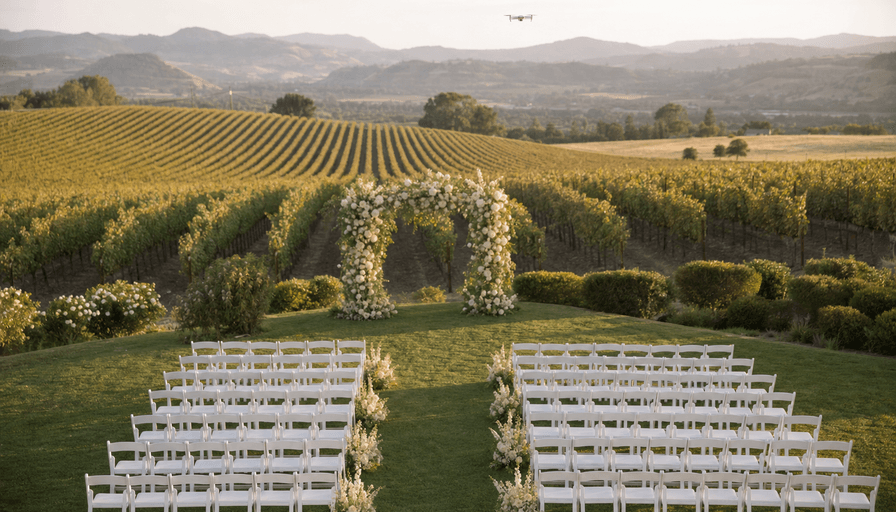
A drone adds $300 to $600 to a wedding photography package in 2026, and for that money you get maybe six to ten minutes of flight spread across your whole day. That sounds thin until you see what those minutes buy: the venue reveal, the wide ceremony frame no ground camera can shoot, and a golden-hour pass of the two of you that ends up being the print over your mantel.
Here's what aerial coverage actually costs this year, which shots a drone nails and which ones it can't touch, the rules that quietly decide where the drone can fly, and the exact questions to ask before you sign anything.
What drone wedding photography costs in 2026
If you're bolting drone coverage onto a photographer you've already booked, expect $300 to $600 in 2026. Hire a dedicated aerial operator for the day and you're looking at $800 to $1,500 for a package that includes both stills and an edited highlight clip. Full cinematic productions with color grading and a scored edit run past $2,000.
For comparison, couples spend around $2,500 on wedding photography and $1,900 on videography on average, so the drone is a small line item that punches above its price. What you're really paying for is a licensed pilot, their insurance, the edit, and the handful of frames you can't get any other way.
A few things push the number up. Beachfront and clifftop weddings cost more because flying over water and gusty coastal air is harder and riskier. Longer events mean more battery swaps and more time on site. And a pilot with a deep portfolio and their own editing suite charges more than a weekend hobbyist, which is usually money well spent. If you want to sanity-check quotes across a wider range of jobs, our drone photography services overview breaks down how aerial pricing works outside the wedding world too.
One expectation to reset early: the drone is not up the entire reception. Between battery life, airspace timing, and guest safety, most weddings get six to ten usable minutes of aerial footage across the day. Good pilots plan those minutes around three or four specific shots rather than hovering aimlessly.
What a drone shoots well at a wedding (and what it doesn't)
Drones are for scale and context. The shots that consistently earn their keep:
- The venue reveal. A slow rise over the property that shows the whole setting, the tent, the tree line, the coast behind it.
- The ceremony wide. A high, static frame of the aisle, the guests, and the couple that a ground photographer physically cannot stand far enough back to get.
- The big group shot. Fifty to a hundred people arranged on a lawn, shot from above so every face is visible.
- The golden-hour couple pass. The two of you alone in a field or on a dock as the drone pulls back and up. This is the money shot.
- The exit. Sparkler tunnels, a getaway car down a long drive, shot from above.
What drones don't do well is anything intimate or indoor. Close-ups are out because propeller downwash blows the bride's veil and hair around, the noise steps on your vows, and hovering a spinning aircraft near people's heads is both unsafe and, in most cases, illegal (more on that below). Rings, table details, the first dance under a low ballroom ceiling: those stay with the ground shooter. A drone is a second camera for the establishing shots, not a replacement for your main photographer.
The hardware matters less than couples think, but it isn't nothing. A pilot flying a DJI Mini 4 Pro has a sub-249-gram aircraft that's quiet and legal to position more flexibly, while something like the DJI Air 3S carries a telephoto lens that grabs tighter aerial portraits from 40 feet away without the rotors buzzing the guests. If you want to go deeper on gear, we cover this in our guide to the best drone for wedding photography.
The rules that shape your coverage: airspace, noise, and flying over guests
This is where most wedding articles wave their hands, and it's the part that actually decides what your footage looks like.
First, the pilot has to be commercial. Any drone operator taking money for wedding footage is required to hold an FAA Part 107 Remote Pilot Certificate. That's not a nice-to-have, it's the law, and it separates an insured professional from a friend with a Mavic. The FAA lays out the requirement on its Part 107 commercial operators page.
Second, airspace. Drones fly below 400 feet, within the pilot's sight, in daylight. If your venue sits under controlled airspace near an airport, the pilot needs airspace authorization, usually granted in near-real-time through the FAA's LAANC system but sometimes requiring a request days ahead. A competent operator checks this the week they book you, not the morning of. Hiring through a network of licensed Part 107 drone pilots is the easy way to make sure that box is checked before the deposit clears.
Third, and this is the one nobody tells you: flying directly over your seated guests is restricted. Under the FAA's Operations Over People rule, only a Category 1 drone, meaning one that weighs under 0.55 pounds and has no exposed rotating parts that could cut someone, can legally fly over a crowd without a special waiver. In practice that means a sub-249-gram drone like the Mini 4 Pro. A heavier professional rig is not allowed to hover above your ceremony. So that dreamy top-down shot of everyone looking up? Either your pilot brings a light drone rated for it, or the aircraft stays to the side and behind the guests and shoots the aisle at an angle. Ask which, because it changes the shot list.
Two more constraints worth knowing. Many venues, and nearly all national and state parks, ban drones outright, so venue permission is on you to confirm. And even where flight is allowed, drones are loud. Most pilots do the noisy work before the ceremony and during cocktail hour, then go quiet for the vows.
Weather and the backup plan
Wind and rain ground drones, full stop. Consumer aircraft handle roughly 20 to 25 mph of wind before footage gets shaky and the flight gets unsafe, and no responsible pilot flies in rain. Since you can't move your wedding date around the forecast, the backup plan is the thing to nail down in advance.
Ask your photographer, in writing, what happens if the drone can't fly. Good answers include a partial refund of the aerial fee, a rescheduled sunset shoot the next morning, or ground-based coverage of the same moments. A vague "we'll see how it looks" is a flag. Also confirm they'll shoot the aerials during a window with decent light: a drone pass at high noon looks flat, while the same shot 30 minutes before sunset is the one you'll actually frame.
The questions to ask before you book
Run through these before you put down a deposit. The answers tell you whether you're hiring a professional or gambling on a hobbyist:
- Are you Part 107 certified, and can you show me the certificate? Non-negotiable for paid work.
- Do you carry liability insurance? A drone incident at a packed venue is exactly what insurance is for. Most venues require proof of it anyway.
- Can you legally fly over our seated guests? If they say yes, they should be flying a sub-249-gram Category 1 drone. If they fly a heavier rig, ask how they'll frame the ceremony from the side.
- Have you checked the airspace over our venue? They should know within a day whether LAANC authorization is needed.
- Who edits the footage, and what's the turnaround? Two weeks is normal; two months is not.
- Do we get the raw footage and full usage rights? Clarify upfront whether you own the files or just the edit, and whether you can post it anywhere you like.
- What's your backup plan if weather grounds the drone? You want a real answer, not a shrug.
FAQ
Is drone wedding photography worth it?
It depends almost entirely on your venue. An outdoor wedding with real scenery, a vineyard, a beach, an estate lawn, gets shots you genuinely can't capture any other way, and the $300 to $600 add-on is easy to justify. A small indoor ceremony gives a drone nothing to do, so skip it and put the money toward more ground coverage.
Can a drone fly directly over my guests during the ceremony?
Only a Category 1 drone, meaning one under 0.55 pounds with no exposed blades that could injure someone, can legally fly over a crowd under FAA rules. Heavier professional drones cannot, so if you want an overhead ceremony shot, confirm your pilot flies a sub-249-gram aircraft. Otherwise the drone shoots the aisle from the side and behind the seats.
How long does the drone actually fly during a wedding?
Less than couples expect. Between battery life, airspace timing, and guest safety, you'll typically get six to ten minutes of usable aerial footage spread across the day. A good pilot spends those minutes on a few planned shots, the venue reveal, the ceremony wide, and a golden-hour couple pass, rather than filming continuously.
Do I need a permit for a drone at my wedding?
The pilot handles the aviation side: the Part 107 certificate and any FAA airspace authorization through LAANC. What's on you is venue permission. Many private venues and almost all national and state parks prohibit drones, so confirm your location allows it before booking the aerial coverage.
What happens if it rains on the wedding day?
Drones don't fly in rain or heavy wind, and your date can't move, so ask about the backup plan before you sign. Reasonable options are a next-morning sunset reshoot, a partial refund of the aerial fee, or reallocating that coverage to the ground. Get the policy in writing.
The bottom line
Drone wedding photography is a small, high-leverage add-on: a few hundred dollars in 2026 for a handful of frames, the venue reveal, the ceremony wide, the golden-hour pull-back, that nothing else in your package can produce. The mistake couples make is booking on the strength of a highlight reel without checking the boring stuff underneath it. Vet the pilot on the license, the insurance, the airspace check, and the over-guests rule, and you'll get the shots you're picturing instead of an excuse about the wind. For the video side of the same decision, our drone video services overview walks through aerial coverage end to end.
Browse licensed drone pilots on DroneServices, or see drone pilots in Atlanta to start with operators near you.