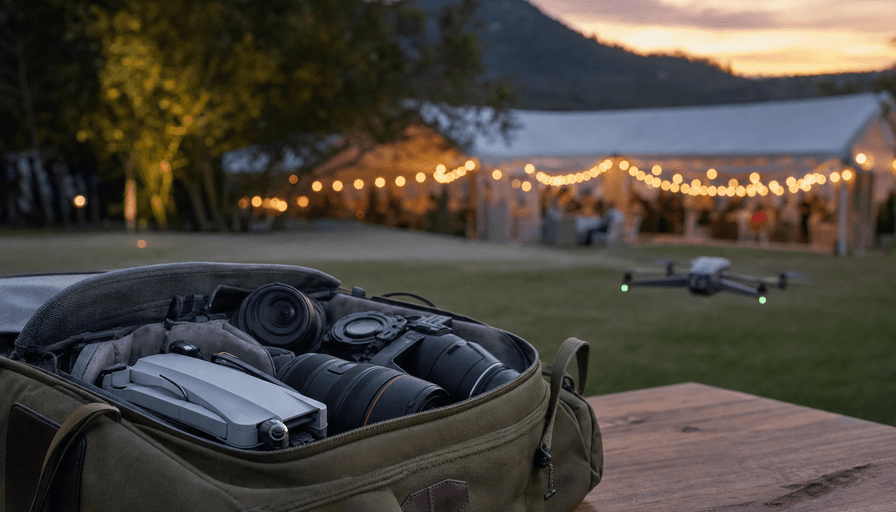
For most couples, the best drone for your wedding is the one you never buy. Hire a licensed pilot for a few hundred dollars and you skip the drone's price tag, the FAA test, the insurance, and the very real chance of a crash on the one day that can't be reshot.
That answer splits two ways, though, and this guide covers both. If you're a couple wondering whether to add aerial coverage, the short version is: hire it. If you're a wedding photographer thinking about adding drone as a service, you actually do need to pick a body, and in 2026 that decision is narrower than the gear lists make it look. By the end you'll know which drone is worth owning, what it costs to hire instead, and the two constraints (noise and airspace) that decide whether a drone can fly at a given ceremony at all.
Couples: you almost certainly want to hire, not buy
Here's the math that the "best drone" roundups skip. A capable wedding-grade drone starts around $759 for a DJI Mini 5 Pro and climbs past $2,000 for a Mavic 4 Pro. That's the cheap part. To fly it for money, or to fly it well enough that your wedding footage isn't shaky garbage, you're also buying a Part 107 license, practice hours, spare batteries, and liability coverage. Then you use it once.
Compare that to hiring. A licensed operator will shoot standalone ceremony and venue coverage for roughly $200 to $600, and photographers who already hold Part 107 usually add aerial to their package for $300 to $800. Full standalone drone wedding packages with cinematic editing run $800 to $1,500, and the more produced ones climb past $2,000. Even at the top of that range, you're paying a pro who has flown fifty weddings, carries insurance, and owns backups if a motor fails mid-flight.
So unless you already fly as a hobby and hold a certificate, buying a drone for your own wedding is a bad trade. Put that budget toward a pilot who has done this before. You can start with our full guide to drone wedding photography, or go straight to how to hire a Part 107 drone pilot and what to ask before you book. If you want to see who's available locally, browse drone pilots in Atlanta as an example of what a real roster looks like.
If you're a wedding photographer, here's what to actually buy
Now the other reader. You shoot weddings, clients keep asking about aerial shots, and you want to add it in-house instead of subcontracting. Good news: you don't need the $2,000 flagship, and you don't need to memorize a spec sheet. Three specs decide a wedding drone, and I'd argue everything else is noise: sensor size (low-light and dynamic range for sunset and dim receptions), weight (under 250 grams changes what the FAA lets you do), and flight time (you can't miss the first kiss swapping batteries).
Against those three, the picks in 2026 are short.
DJI Mini 5 Pro (around $759) is the default I'd hand most wedding shooters. It weighs 249 grams, which keeps it in the FAA's lightest category, and it still carries a 1-inch sensor shooting 50MP stills, the same class of sensor as drones twice its weight a generation ago. Battery life reaches into the 40-to-50-minute range with the extended pack. For a single-operator wedding shooter, it's the most drone you can fly with the fewest restrictions. Here are the full specs on DJI's product page.
DJI Air 3S (around $1,099) is the all-rounder if you shoot at windy coastal venues or want a telephoto option. It's heavier, so it drops out of the sub-250g category, but the dual-camera system and its 3x zoom let you frame the couple tighter from farther away, which matters more at weddings than it sounds (more on that in the noise section). Better wind resistance is the real reason to step up here.
DJI Mavic 4 Pro (around $2,099) is the premium pick and honestly overkill for most wedding work. If aerial cinematography is becoming a signature part of your brand and you're also shooting real estate or commercial jobs, the larger sensor and Hasselblad color earn their keep across your whole business, not just weddings. For weddings alone, it's more than the day needs.
Not everything is DJI. The Autel EVO line is the serious non-DJI alternative, worth a look if you want a drone from a company that isn't facing US import uncertainty. But the software polish, the obstacle avoidance, and the resale market still favor DJI for a working shooter today.
The quiet problem nobody mentions until the vows
This is the part the gear guides bury. A drone at close range is loud. Most consumer drones put out 60 to 70 decibels from about three feet away, which is roughly a raised conversation, and it carries. Fly one low over a silent ceremony during the vows and you will hear it on every microphone, and so will the couple.
The fix is altitude and zoom, not a magic silent drone. At around 100 feet up, the same drone drops to a faint hum that most ceremony mics won't pick up, and a telephoto or zoom camera lets you keep the frame tight from that distance. This is the actual argument for the Air 3S over a fixed-lens drone: the zoom buys you height, and height buys you silence.
The other lever is weight. Smaller sub-250g drones like the Mini 5 Pro are simply quieter and less intimidating hovering near a crowd. The DJI Neo 2, at 151 grams, is the quietest thing going, but it isn't sold in the US as of mid-2026, so it's a note rather than a recommendation here. The practical move at any wedding is the same regardless of model: get your establishing shots before and after the ceremony, and kill the aerial during the vows themselves. No footage is worth stepping on the moment. If you're building a package, pair the drone with ground aerial video coverage so the highlight reel doesn't depend on flying at the wrong time.
What the law actually allows over a wedding crowd
Two rules matter, and both are easy to get wrong. First, any drone flight you're paid for is commercial, which means the pilot needs an FAA Part 107 certificate. That's a real credential, not a formality: it's a $175 knowledge exam, a $5 drone registration good for three years, and free recurrent training every 24 months. The FAA lays out the process on its become a certificated remote pilot page. If a "pilot" you're hiring can't produce their certificate number, that's a hard stop.
Second, you generally can't fly directly over people who aren't part of the operation. The FAA's operations over people rules sort drones into categories by weight and safety features, and sustained flight over an open-air assembly (a seated crowd of ceremony guests counts) requires a drone that meets Category 2 or 3 standards and broadcasts Remote ID. In plain terms, this is why good wedding pilots fly around and above the venue, over the aisle and the couple, rather than parked over rows of guests. It's also why the lightweight, prop-guarded, sub-250g drones come up so often: they carry the fewest restrictions when people are nearby.
Indoors is a different world. FAA airspace rules don't apply inside a building, so Part 107 categories don't either, but that doesn't make it a good idea. Only a small drone with omnidirectional obstacle avoidance belongs anywhere near a reception, and plenty of venues ban indoor flight outright. Always ask the venue first. This is the kind of judgment you're paying for when you book professional drone photography instead of handing a cousin a drone.
The real cost math: hire vs buy
Put the two readers side by side and the decision gets obvious. A couple pays $300 to $800 to add aerial to an existing photo package, or $800 to $1,500 for standalone drone coverage, and gets a licensed, insured, experienced operator for it. Buying the equivalent capability means $759 and up for the drone, plus licensing, plus insurance, plus the learning curve, for a skill you'll use once.
For a photographer, the same numbers flip. If you're already booking weddings, a $759 Mini 5 Pro that lets you charge $300 to $800 more per event pays for itself in two or three weddings, and every one after that is margin on a service your competitors may not offer. That's the case for buying: not that drones are cheap, but that the drone becomes a billable line on jobs you're already shooting.
Frequently asked questions
Do you need a license to fly a drone at a wedding?
For any paid work, yes. Commercial drone flights in the US require an FAA Part 107 Remote Pilot Certificate, and flying commercially without it is illegal and voids insurance. A couple flying their own hobby drone at their own wedding is recreational and doesn't need Part 107, but the venue's rules and liability still apply, so ask first.
Can a drone fly indoors at the reception?
Technically yes, because FAA airspace rules stop at the door, but it's risky. Only a small drone with omnidirectional obstacle avoidance, like the DJI Mini 4 Pro or Mini 5 Pro, is safe in a crowded room, and many venues prohibit indoor flight entirely. Confirm with the venue before you plan any indoor shots.
How much does it cost to add drone coverage to a wedding?
Expect $300 to $800 to add aerial to an existing photo or video package, and $800 to $1,500 for standalone drone coverage with edited highlights. More produced cinematic packages can run past $2,000. The range depends on ceremony length, venue complexity, and how much editing is included.
Is the DJI Mini 5 Pro good enough for professional wedding work?
For most wedding shooters, yes. Its 1-inch sensor handles sunset and dim-light scenes well, and at 249 grams it stays in the FAA's lightest category, which means fewer restrictions flying near guests. Step up to the Air 3S only if you regularly shoot windy coastal venues or want zoom.
Will the drone ruin the ceremony audio?
Not if it's flown right. Up close a drone runs 60 to 70 decibels, loud enough to bleed onto every mic, but at about 100 feet of altitude it fades to a hum most ceremony mics miss. The rule good pilots follow is simple: get the aerial shots before and after, and don't hover low during the vows.
The bottom line
If you're a couple, hire a licensed pilot and put the drone budget toward someone who has done this fifty times. If you're a wedding photographer adding the service, buy a DJI Mini 5 Pro, get your Part 107, and let it pay for itself over your next few bookings. Either way, the drone is the easy part. Noise and airspace are what actually decide the shot, so plan the flight around the ceremony, not the other way around. When you're ready to find someone who already knows all of this, browse drone service providers on DroneServices or see drone pilots in Atlanta to start.